How to Play American Mahjong (Beginner's Guide)
American mahjong is played by four people with 152 tiles, including eight jokers. Before play starts, everyone swaps unwanted tiles in a passing round called the Charleston. Then you draw and discard, aiming to build one of the hands printed on that year's card. The first player to complete a hand from the card calls "Mahjong!" and wins.
The draw-and-discard rhythm is the same as in every style of mahjong. If you've never played any kind, read how to play mahjong first for the basics, then come back here for what makes the American game different.
On this page
The American set
An American set has 152 tiles:
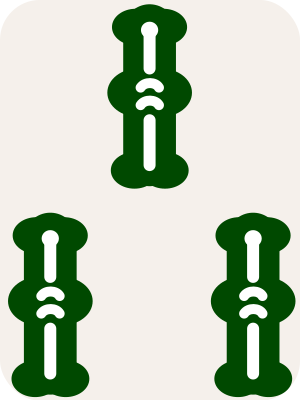
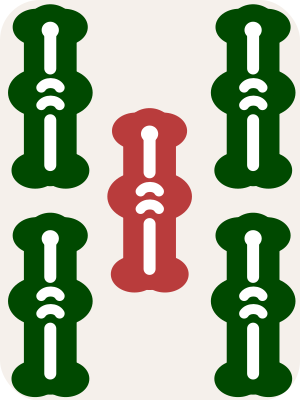
- Three suits, numbered 1 to 9, with four of each tile: DotsOne of the three suits, drawn as circles.See the full glossary, BamsOne of the three suits, drawn as bamboo sticks. The 1 of bams is usually a bird instead of a single stick.See the full glossary and CraksOne of the three suits. Each tile shows a Chinese number above the character for ten thousand.See the full glossary.
- Four winds: North, East, West and South, four of each.
- Three dragons: Red, Green and White, four of each.
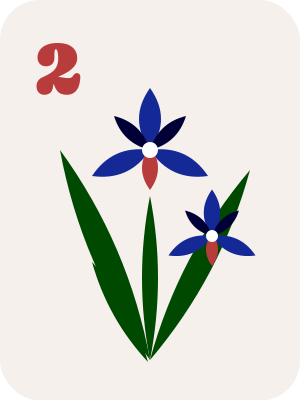
- Eight flowers. Any flower counts as any other, whatever its picture or number.
- Eight jokers, the wild tiles that make the American game different.







Each DragonsThree honor tiles: Red, Green and White, four of each. In American mahjong each dragon is paired with a suit, and the White Dragon is called Soap.See the full glossary goes with one suit. Red goes with craks, Green with bams, and White with dots. American players call the White Dragon SoapThe American name for the White Dragon, which in American sets is drawn as a frame, often blue. On the card it can also stand for zero.See the full glossary, and on the card it can also stand for a zero, as in the year 2026.
Most American sets come with four racks. Your rack holds your tiles facing you, and the wall sits along the front of it. Many sets also include a few spare or blank tiles: take those out before you play.
The yearly card and how to read it
Every winning hand in American mahjong comes from The cardThe list of winning hands for American mahjong, published each year by the National Mah Jongg League. Every player needs the current year's card.See the full glossary, a folded sheet published once a year by the National Mah Jongg League. The hands change every year, so every player at the table needs a copy of the current card. The new card arrives each spring, and groups usually switch to it once everyone has one.
You don't need to memorize the card. You read it while you play, especially in your first year. Here's how it's laid out:
- Sections. Hands are grouped into sections with headings, such as hands built on even numbers or on the current year. The sections vary from year to year.
- One line per hand. Each line shows the 14 tiles you need, written as numbers and letters in groups.
- Colors. Groups printed in the same color in a hand must be the same suit. A different color means a different suit. The colors don't stand for particular suits, so you choose which suits to use.
- X or C. An X after a hand means it can be exposed: you may call discards to make its groups. A C means concealed: you build the whole hand yourself and may call only the winning tile.
- Value. Each hand has a number, its value in points. Simpler hands are worth less; hard and concealed hands are worth more.
This guide never shows hands from the card. Hands are the League's work, and the card is what tells you this year's hands. Our page on the 2026 mahjong card explains how to read it and where to buy it.
Setting up and dealing
Find East and build the walls
Everyone rolls the dice, and the highest roll becomes East, the DealerThe player who starts the hand with 14 tiles and discards first. The dealer always sits in the East seat.See the full glossary. Shuffle the tiles face down, then each player builds a wall 19 tiles long and two high in front of their rack, and pushes it toward the middle at an angle so the four walls form a square.
Break the wall
East rolls the dice again and counts that many stacks from the right-hand end of East's own wall, then separates the wall there.
Deal 13 tiles each, 14 to East
Starting with East and moving to the right, each player takes four tiles (two stacks) from the left of the gap, until everyone has 12. Then East takes two more tiles and everyone else takes one. East ends with 14 tiles and everyone else with 13. Stand your tiles on your rack, facing you.
The Charleston, step by step
Before anyone discards, players swap tiles in the CharlestonThe tile swap at the start of an American mahjong hand. Everyone passes three unwanted tiles right, then across, then left, and may agree to a second round and a final courtesy pass.See the full glossary. You pass three tiles you don't want and receive three from someone else, which gives everyone a chance to move toward a hand on the card. Always put your three tiles face down in front of the player you're passing to before you pick up the tiles passed to you.
First Charleston: right, across, left
The first Charleston is required. Everyone passes three tiles to the right, then three across, then three to the left.
On the last of these passes, to the left, you may make a Blind passIn the Charleston, passing on tiles you've just been handed without looking at them, instead of tiles from your own hand. Allowed only on certain passes.See the full glossary: pass on one, two or three of the tiles you were just given without looking at them.
Second Charleston: left, across, right (optional)
If everyone agrees, you go round again in the opposite order: left, across, then right. Any one player can stop the second Charleston, for any reason, once the first Charleston is done. A blind pass is allowed again on the last pass, to the right.
Courtesy pass: across
Finally, you and the player across from you may swap up to three tiles. Each of you says how many you'd like to swap, and you both pass the smaller number. The Courtesy passThe optional last step of the Charleston: you and the player across from you agree to swap none, one, two or three tiles.See the full glossary can happen even if the second Charleston was stopped.
You can never pass a JokerA wild tile in American mahjong. It can stand in for any tile in a group of three or more identical tiles, but never in a pair or as a single tile. Jokers can't be passed in the Charleston.See the full glossary. If someone passes you one by mistake, hand it back.
Try it yourself. The step-by-step view walks through every pass, and the practice view deals you a random hand to pass from:
Step 1 of 7
First Charleston, pass 1: right
Everyone chooses three tiles they don't want and passes them face down to the player on their right. Pick up the three tiles passed to you only after you have passed yours.
Playing a turn
After the Charleston, East discards one tile to start. Play then goes to the right, and each turn has the same rhythm: draw a tile from the wall, then DiscardThe tile you give up at the end of your turn, placed face up in the middle of the table and named out loud.See the full glossary one tile, saying its name out loud. Between turns you always hold 13 tiles.
Keep your card in front of you. As tiles arrive, look for the two or three hands on the card that your tiles fit best, and let go of tiles that don't help any of them. Many players settle on one hand after the Charleston and switch only if the tiles push them toward another.
Jokers
Jokers are what make the American game fast. A joker can stand in for any tile, with three limits:
- Only in groups of three or more identical tiles: a PungThree identical tiles, such as three 7 Bams or three Red Dragons. You can call a pung from any player's discard.See the full glossary (3), KongFour identical tiles. In Chinese and Japanese mahjong, a kong counts as one set and you draw a replacement tile after making it.See the full glossary (4), QuintFive identical tiles in American mahjong. Because a set has only four of each tile, a quint always needs at least one joker (or flowers).See the full glossary (5) or sextet (6).
- Never in a PairTwo identical tiles. A standard Chinese or Japanese winning hand is four sets and one pair.See the full glossary or as a single tile. Hands made only of pairs and singles can't use jokers at all.
- Never passed in the Charleston.

Joker exchange. If a player has a joker in an exposed group and you hold the real tile it stands for, you can swap them on your turn. You do it after you draw (or call) and before you discard, and you can take jokers from anyone's exposures, including your own. This Joker exchangeOn your turn, swapping a real tile from your hand for a joker in any player's exposure, when your tile is the one the joker stands for.See the full glossary is often the quickest way to finish a hand.
A discarded joker is dead. Nobody can call it. Some players discard a joker on purpose when it's the safest tile to throw.
Exposures and calling
When someone discards a tile you need, you can CallTaking a tile another player has just discarded, to complete a set or to win. You say the name of the set, such as "pung", and lay the set face up.See the full glossary it, but only in two situations:
- To complete a group of three or more identical tiles in your hand: a pung, kong, quint or sextet. Say "Call", take the tile, and lay the whole group face up on top of your rack. This is an ExposureA set you have laid face up on your rack, usually after calling a discard. Exposed sets can't be changed later.See the full glossary.
- To win. If the tile completes your hand, you can call it for any part of the hand, even a pair or a single.
You can't call a discard for a pair or a single tile unless it gives you mahjong, and there are no runs to call. Only the most recent discard can be called. Your chance ends once the next player has drawn and racked their tile, or has discarded.

If two players call the same discard, a call for mahjong wins. Otherwise, the player next in turn after the discarder gets it. After an exposure, you discard, and play continues to your right.
Exposing tells everyone at the table which hands you might be making, and it means you can't change those tiles later. If your hand is marked C on the card, you can't expose at all.
Going out: calling mahjong
When your 14 tiles exactly match one hand on the card, call "Mahjong!What you call when your hand is complete and you win. The word is also the name of the game.See the full glossary" and lay your tiles face up for everyone to check against the card. You can win with a tile you drew from the wall, or by calling another player's discard.
Check carefully before you call. If you call mahjong by mistake and have already shown your tiles, your hand can be declared a Dead handA hand that can no longer win, for example because it has the wrong number of tiles or its exposures can't match any hand on the card. The player stops trying to win but stays in the game.See the full glossary. A dead hand also happens if you have the wrong number of tiles, or if your exposures can no longer match any hand on the card. You stop drawing and discarding for the rest of that hand, and you still pay the winner.
If the wall runs out before anyone wins, it's a Wall gameA hand where the wall runs out before anyone wins. No one is paid, and a new hand is dealt.See the full glossary. Nobody pays, and the next player to the right becomes East.
Scoring basics
Every hand on the card has a value. Many groups play for small stakes, such as 25 cents for a 25-point hand, and others just keep score on paper. Values on the card usually start at 25, and the hardest hands are worth more.
When someone wins:
- Won on a discard: the player who discarded the winning tile pays double the hand's value. The other two players pay the value once.
- Self-drawn: if the winner drew the winning tile from the wall, all three players pay double. Winning after a joker exchange counts as self-drawn.
- Jokerless: a hand completed with no jokers at all is worth double again. This bonus doesn't apply to hands that can't use jokers anyway, such as hands made of pairs and singles.
For a hand worth 25:
| How it was won | Discarder pays | Each other player pays | Winner collects |
|---|---|---|---|
| On a discard | 50 | 25 | 100 |
| Self-drawn | 50 | 50 | 150 |
| On a discard, jokerless | 100 | 50 | 200 |
| Self-drawn, jokerless | 100 | 100 | 300 |
There's no bonus for being East in American mahjong. Many groups also cap how much a player can lose in a session.
Common beginner mistakes
- Exposing too early. Once a group is face up, you can't change hands without it. Wait until you're fairly sure.
- Calling for a pair. You can only call a discard for a pair or single when it gives you mahjong.
- Forgetting the colors. Groups in different colors on a hand must be in different suits.
- Skipping the joker exchange. Check other players' exposures every turn. A joker you can swap for is a free wild tile.
- Passing a joker. It's never allowed in the Charleston, even blind.
- Discarding a tile someone needs late in the hand. If a player has three exposures, look at what they might need before you throw a tile they could win on.
FAQ
What is the difference between American and Chinese mahjong?
American mahjong uses 152 tiles with jokers, starts with the Charleston, and every winning hand must match that year's card. Chinese mahjong uses 144 tiles without jokers, has no card, and wins with four sets and a pair, including runs called chows. See how to play Chinese mahjong.
Do I need a new card every year?
Yes. The hands change every year, and groups play from the current card once everyone has it. The card is inexpensive and comes from the National Mah Jongg League.
Can you use a joker in a pair?
No. Jokers can only be used in groups of three or more identical tiles. They can never be part of a pair or stand in for a single tile.
Is the second Charleston required?
No. The first Charleston is required, but the second is optional, and any one player can choose to stop it. The courtesy pass can still happen afterward.
Can you pick up a discarded joker?
No. Once a joker is discarded, it's dead and no one can call it.
How many tiles do you need to win in American mahjong?
Fourteen, matching one hand on the card exactly. You hold 13 between turns and win on the 14th tile, whether you drew it or called it.
New to the tiles? The mahjong tiles guide shows every tile in an American set. Keep the printable cheat sheet by the table, and see the beginner's hub for every guide.