How to Play Mahjong: A Step-by-Step Beginner's Guide
Mahjong is a game for four players with 144 tiles. On each turn you draw a tile and discard one, slowly swapping your 13 tiles toward a complete hand of four sets and a pair. The first player to finish their hand calls "Mahjong!" and wins.
This guide teaches the classic game that Chinese and Japanese mahjong share, one step at a time, with a picture for every step. If your group plays American mahjong with a yearly card, the setup and turns work the same way. Look out for the American notes, then read the American mahjong guide.
On this page
The goal
Your hand starts with 13 tiles. To win, you need 14 tiles arranged as four sets and one pair. A set is three or four tiles that belong together:
- a PungThree identical tiles, such as three 7 Bams or three Red Dragons. You can call a pung from any player's discard.See the full glossary: three identical tiles
- a KongFour identical tiles. In Chinese and Japanese mahjong, a kong counts as one set and you draw a replacement tile after making it.See the full glossary: four identical tiles, which counts as one set
- a ChowThree tiles in a row in the same suit, such as 4-5-6 of dots. Used in Chinese and Japanese mahjong, not in American mahjong. You can call a chow only from the player on your left.See the full glossary: three tiles in a row in the same suit, such as 3, 4 and 5 of dots
A PairTwo identical tiles. A standard Chinese or Japanese winning hand is four sets and one pair.See the full glossary is two identical tiles. Here is a complete winning hand:


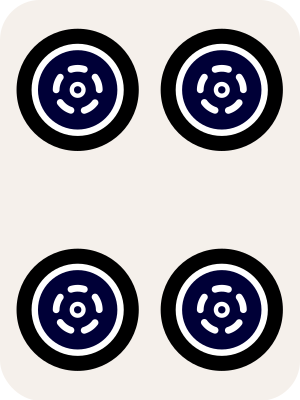
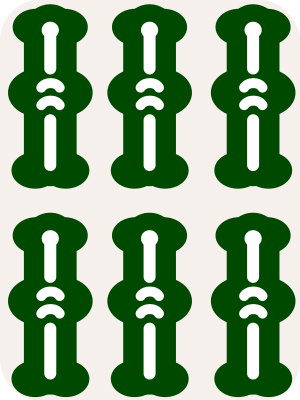
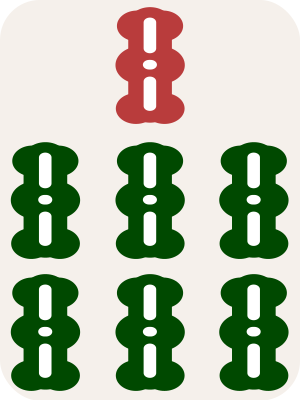

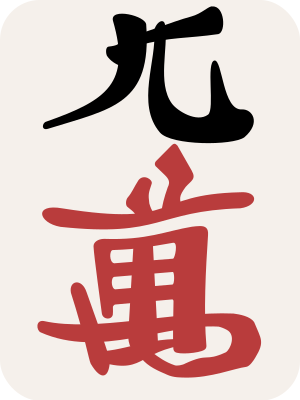
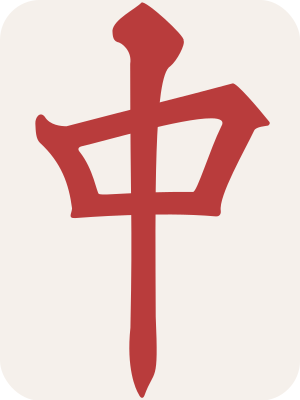
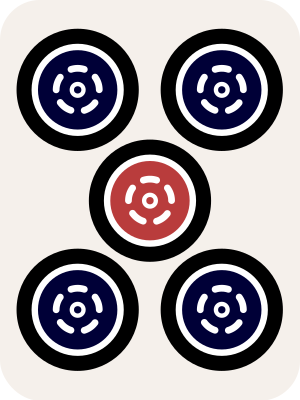
You get closer to a hand like this by drawing tiles from the WallThe face-down tiles stacked two high in a square in the middle of the table. Everyone draws from it in turn.See the full glossary and by taking tiles other players throw away, then letting go of the tiles you don't need. Most of the skill is deciding what to keep.
What you need
- A mahjong set. A Chinese set has 144 tiles. Japanese mahjong uses 136 of them (no flowers), and American sets have 152 (with jokers). The mahjong tiles guide shows every tile, and our guide to mahjong sets explains what to look for when you buy one.
- Four players. You can play with two or three, with some changes, but the game is built for four.
- Two or three dice to decide where the wall is opened.
- A square table, ideally with a cloth or mat so the tiles are quieter and easier to shuffle. See our guides to mahjong tables and mahjong mats.
- Something to score with. Many groups play for points written on paper; others use chips.
Racks to hold your tiles are optional in Chinese and Japanese play and standard in American play.
The tiles
A Chinese set has three kinds of tiles.
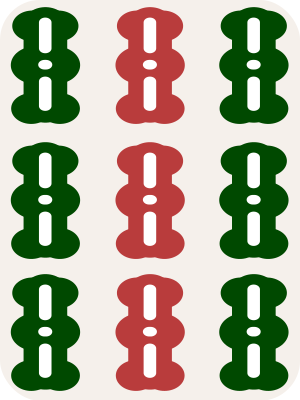
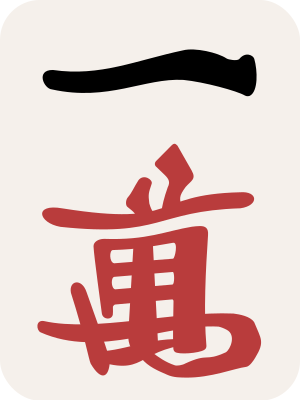
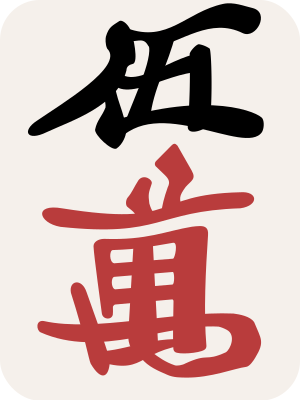
Suits. There are three SuitsThe three families of numbered tiles: dots, bams and craks, each numbered 1 to 9 with four copies of every tile.See the full glossary, numbered 1 to 9, with four copies of every tile: DotsOne of the three suits, drawn as circles.See the full glossary, BamsOne of the three suits, drawn as bamboo sticks. The 1 of bams is usually a bird instead of a single stick.See the full glossary (bamboo) and CraksOne of the three suits. Each tile shows a Chinese number above the character for ten thousand.See the full glossary (characters). The 1 Bam is usually drawn as a bird.

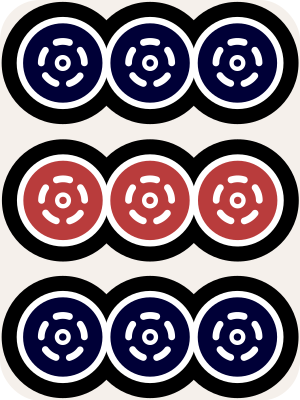

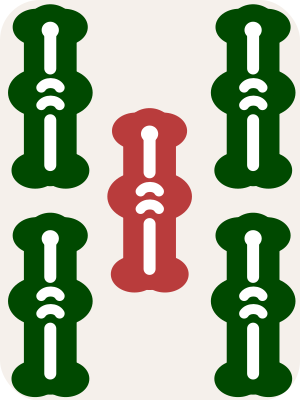
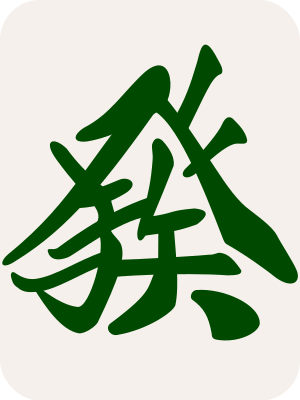
Honors. The Honor tilesThe winds and dragons. They have no numbers, so they can form pungs and kongs but never runs.See the full glossary have no numbers. There are four WindsFour honor tiles: East, South, West and North, four of each. Each seat at the table is also named after a wind.See the full glossary (East, South, West, North) and three DragonsThree honor tiles: Red, Green and White, four of each. In American mahjong each dragon is paired with a suit, and the White Dragon is called Soap.See the full glossary (Red, Green, White), four of each. Honors can make pungs and kongs, but never chows.





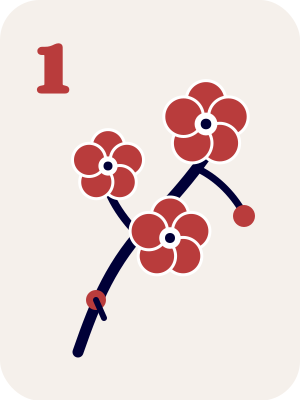
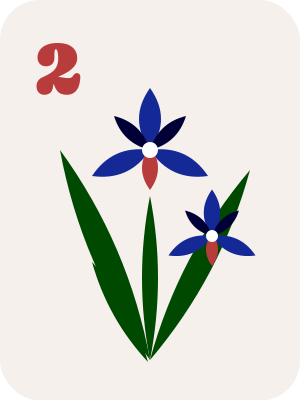
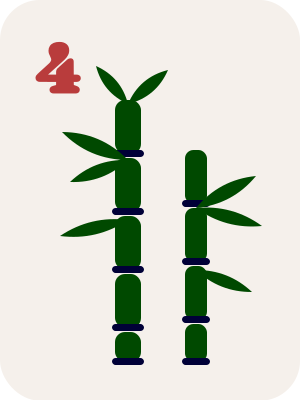
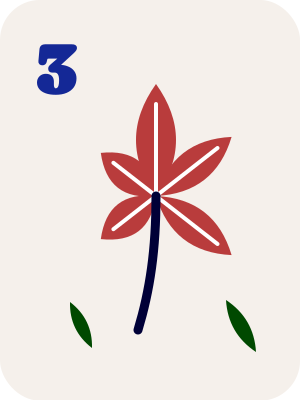
Bonus tiles. Chinese sets add four FlowersBonus tiles. Chinese sets have four flowers and four seasons, which you set aside when drawn and replace. American sets have eight flowers, which are used in hands like any other tile.See the full glossary and four seasons. They are never part of a set. When you draw one, you put it face up beside you and draw another tile in its place.




Setting up and building the wall
Choose seats and find East
Sit four around a square table. Each seat is named after a wind. The DealerThe player who starts the hand with 14 tiles and discards first. The dealer always sits in the East seat.See the full glossary is East. South sits on East's right, West sits opposite, and North sits on East's left. Choose the first dealer by rolling the dice: the highest roll is East.
Play always moves to the right, from East to South to West to North. That's counterclockwise if you look down at the table.
Shuffle the tiles face down
Turn every tile face down and mix them around the middle of the table with flat hands. Everyone helps. Take out any spare or blank tiles first, so only the playing tiles are left.

Every tile goes face down before shuffling. Build the four walls
Each player builds a wall in front of them: a row of 18 stacks, two tiles high, face down. Then push the four walls together into a square. The walls hold the tiles you'll draw from for the rest of the hand.
Roll the dice and break the wall
East rolls the dice and counts that many stacks along a wall from its right-hand end, then opens a gap there. This is called Break the wallChoosing where in the wall to start dealing, usually by rolling dice. The tiles are dealt from that gap.See the full glossary. Tiles are taken from the left side of the gap, so the wall shrinks clockwise around the square, while players take their turns to the right.
Dealing
Starting with East and moving to the right, each player takes a block of four tiles (two stacks) from the wall. Go round three times, so everyone has 12 tiles. Then East takes two more tiles and everyone else takes one.
East now has 14 tiles and everyone else has 13. Stand your tiles on edge so only you can see them, and sort them by suit. If you have any flowers or seasons, put them face up beside you and draw replacements from the far end of the wall, starting with East.
A turn, step by step
East starts by discarding one tile, because East already has 14. After that, every turn has the same rhythm.
Draw a tile
Take the next tile from the wall, going clockwise from where the dealing stopped. Don't show it to anyone. You now have 14 tiles.

You drew the 5 Dot, which pairs with the one you already had. Look for what you can keep
Group your tiles into finished sets, pairs, and tiles that are one away from a set. The loose tiles that don't fit anywhere are the ones to let go.
Grouped: one chow, three pairs, two bams that need an 8 or a 5, and three loose tiles. Discard one tile
Place one tile face up in the middle of the table and say its name out loud, for example "North". This is your DiscardThe tile you give up at the end of your turn, placed face up in the middle of the table and named out loud.See the full glossary. You're back to 13 tiles.
A lone North Wind is a common early discard. Play passes to the right
The player on your right takes their turn next, unless someone calls your discard. Keep going round until someone wins or the wall runs out.
Calling tiles: pung, kong and chow
You don't have to wait for the wall. When another player discards a tile you need, you can CallTaking a tile another player has just discarded, to complete a set or to win. You say the name of the set, such as "pung", and lay the set face up.See the full glossary it: say the name of the set you're making, take the tile, and lay the finished set face up in front of you. That set is now an ExposureA set you have laid face up on your rack, usually after calling a discard. Exposed sets can't be changed later.See the full glossary, and you can't change it later. Then you discard, and play continues to your right, which may skip some players.
Pung. If you hold two of a tile and someone discards the third, call "Pung!" You can call a pung from any player.
Kong. If you hold three of a tile and someone discards the fourth, call "Kong!" Because a kong uses four tiles but counts as one set, you then draw a replacement tile from the far end of the wall before you discard. You can also make a kong from tiles you draw yourself, or add a tile you draw to a pung you've already exposed.
Chow. If you hold two tiles in a row, such as 6 and 7 Bam, and the player on your left discards the 5 or the 8, you can call "Chow!" A chow can only come from the player just before you.
When two players want the same tile. A call to win beats everything. A pung or kong beats a chow. If two players want the same tile for the same reason, the next one in turn order gets it.
Going out: calling mahjong
When the tile you need arrives, you've won. If you drew it from the wall, it's a Self-drawnWinning with a tile you drew from the wall yourself, rather than one someone discarded. Most scoring systems pay extra for it.See the full glossary win. If someone discarded it, you can call it from any player, even out of turn. Either way, say "Mahjong!What you call when your hand is complete and you win. The word is also the name of the game.See the full glossary" and lay your whole hand face up so everyone can check it: four sets and a pair, 14 tiles in total.
A hand that is one tile away from winning is ReadyOne tile away from winning.See the full glossary. Some ready hands can win with more than one tile, which is worth aiming for.
If the wall runs out before anyone wins, the hand is a Wall gameA hand where the wall runs out before anyone wins. No one is paid, and a new hand is dealt.See the full glossary. No one scores, and the tiles are shuffled for a new hand.
Who deals next. If East wins, or the wall runs out with no winner, East usually deals again. Otherwise the deal passes to the right, and South becomes the new East. Four rounds of deals make a full game, named East, South, West and North after the Prevailing windThe wind of the current round. The game starts in the East round; a pung of the prevailing wind scores extra in Chinese and Japanese mahjong.See the full glossary.
A full example round
Here's one short hand from your seat, so you can see how the pieces fit. You're South, so you play second. After the deal, your 13 tiles look like this:
Turn 1. East discards a West Wind, which you don't need. You draw a 5 Dot, which pairs your 5 Dot, so you keep it. You discard the North Wind, the tile least likely to join anything.
Turn 2. West discards a Red Dragon. You hold two, so you call "Pung!", take it and lay the three dragons face up. Now you must discard: you let go of the 1 Crak, since 1s can only join a run one way.
Turn 3. Play went to your right after your call, so it comes back round. East, the player on your left, discards an 8 Bam. That finishes your 6-7 Bam, so you call "Chow!" and lay the run face up. You discard the 8 Dot.
Turn 4. Look at what you have: two finished sets on the table, a chow of dots in your hand, and two pairs. You're ready, waiting on either a 9 Crak or a 5 Dot.
Turn 5. You draw a 9 Crak from the wall. "Mahjong!" You lay out your hand: pung of Red Dragons, chow of 6-7-8 Bams, chow of 2-3-4 Dots, pung of 9 Craks and a pair of 5 Dots.
Scoring, briefly
How a win is scored depends on the style, and every group has its own habits. The simplest way to start is to give the winner a point and keep a tally. Once everyone is comfortable, add your style's real scoring:
- Chinese (Hong Kong): count the winning hand's faan, such as 1 for each dragon pung and 1 for a self-drawn win, and pay from an agreed table.
- Japanese: count han and fu, then look up the points. It's detailed, so most beginners use a scoring chart or an app.
- American: each hand on the card has a printed value, and the payment depends on how the hand was won.
Two features earn extra in almost every style: winning with a tile you drew yourself, and winning without calling any discards. Agree on your scoring before the first hand, not after the first win.
How the styles differ
Every style uses the same rhythm of draw, discard and call. What changes is the set of tiles and what counts as a winning hand.
| American | Chinese (Hong Kong) | Japanese (riichi) | |
|---|---|---|---|
| Tiles | 152, with 8 jokers and 8 flowers | 144, with 4 flowers and 4 seasons | 136, no flowers |
| Winning hands | Must match a hand on that year's card | Four sets and a pair, plus a few special hands | Four sets and a pair, with at least one scoring pattern (YakuA scoring pattern in Japanese mahjong. Your winning hand must contain at least one yaku, or it can't win.See the full glossary) |
| Chows | Not used | Called from the player on your left | Called from the player on your left |
| Before play | Players swap tiles in the CharlestonThe tile swap at the start of an American mahjong hand. Everyone passes three unwanted tiles right, then across, then left, and may agree to a second round and a final courtesy pass.See the full glossary | Flowers replaced | No swapping |
| Scoring | Value printed on the card | Faan, with a minimum to win | Han and fu, with bonus tiles called DoraBonus tiles in Japanese mahjong. Each dora in your winning hand adds value, but dora alone can't make a hand a winner.See the full glossary |
If you're joining a group, ask which style they play before you buy a set or learn scoring. The Chinese mahjong guide and the American mahjong guide go further into each.
Test yourself: is it a set?
Choose a style, look at the tiles, and decide what they make. Each answer comes with the reason.
Score: 0 of 0
Is this a valid set?
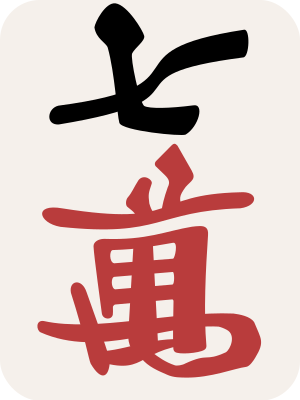
Tiles: 7 Crak, 7 Crak, 7 Crak
Common beginner mistakes
- Forgetting to discard. Every turn ends with a discard, including the turn you call a tile. Count your tiles: 13 between turns, 14 only while it's your move.
- Calling a chow from the wrong player. You can chow only from the player on your left. Pungs, kongs and winning tiles can come from anyone.
- Not drawing after a kong. A kong uses an extra tile, so take a replacement from the far end of the wall before you discard.
- Holding every honor. Single winds and dragons can only become pungs, and only if two more turn up. Unless you already have a pair, they are good early discards.
- Exposing too fast. Every set you call shows the table what you're collecting, and some scoring rewards a hand you kept hidden. Call when it clearly helps.
- Discarding without watching. If three players have thrown away a tile, the fourth copy is the only one left. Watch the discards before you wait on a tile that might not come.
FAQ
How many tiles do you start with in mahjong?
Every player starts with 13 tiles, except the dealer (East), who starts with 14 and begins by discarding one. A winning hand has 14 tiles, because you win on the tile you draw or call.
Does mahjong go clockwise or counterclockwise?
Turns go to the right, which is counterclockwise when you look down at the table: East, South, West, then North. Tiles are taken from the wall in the other direction, clockwise.
Can you play mahjong with fewer than four people?
Yes. Two- and three-player versions remove some tiles or seats and change a few rules. Most groups still treat four as the real game.
How long does a game of mahjong take?
A single hand often takes 5 to 15 minutes once everyone knows the rules. A full game of four rounds can take two to four hours, so many groups play a set number of hands or stop at a set time.
Is mahjong hard to learn?
The turn itself is simple: draw, decide, discard. The hard part is learning which sets to aim for, and that comes after a few hands. Play your first games with the tiles face up, or with a cheat sheet beside you.
What does it mean to call mahjong?
It means you've completed a winning hand. You say "Mahjong!" and show your tiles so everyone can check them before the hand is scored.
For more help, start from the beginner's hub, keep the printable cheat sheet by the table, and look up any word in the glossary.