How to Play Chinese Mahjong: Rules and Scoring
Chinese mahjong is played by four people with 144 tiles. You draw and discard to build a hand of four sets and a pair, calling other players' discards to complete pungs, kongs and runs. The first to finish calls "Mahjong!" and scores points, called faan, for the features of their hand.
This guide follows Hong Kong mahjong, the style most Chinese families and clubs play at home, and notes where the international competition rules (Chinese Official) and other groups differ. For a gentler first lesson with a full example round, start with how to play mahjong.
On this page
The tiles
A Hong Kong set has 144 tiles:
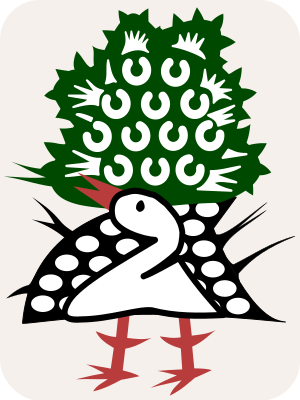
- Three suits, 1 to 9, four of each: DotsOne of the three suits, drawn as circles.See the full glossary, BamsOne of the three suits, drawn as bamboo sticks. The 1 of bams is usually a bird instead of a single stick.See the full glossary and CraksOne of the three suits. Each tile shows a Chinese number above the character for ten thousand.See the full glossary (108 tiles).
- Winds: East, South, West and North, four of each (16 tiles).
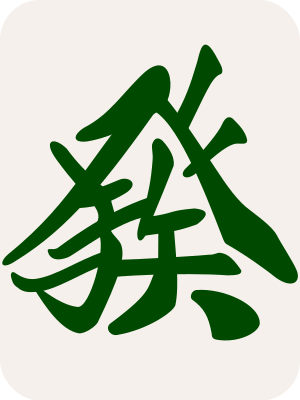
- Dragons: Red, Green and White, four of each (12 tiles).
- Flowers and seasons: plum, orchid, chrysanthemum and bamboo, plus spring, summer, autumn and winter, one of each (8 tiles).
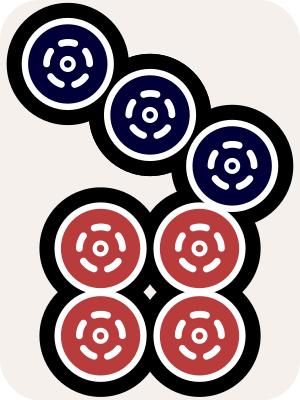
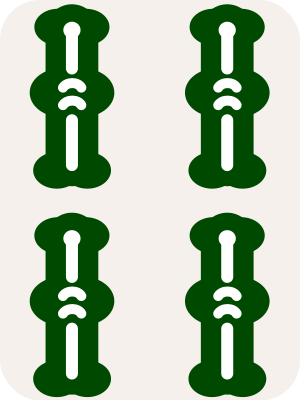
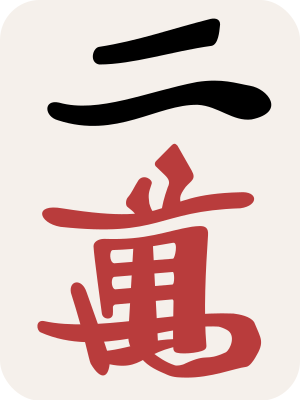
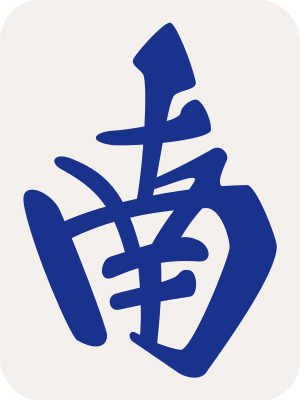

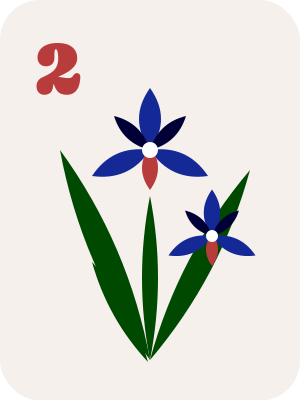
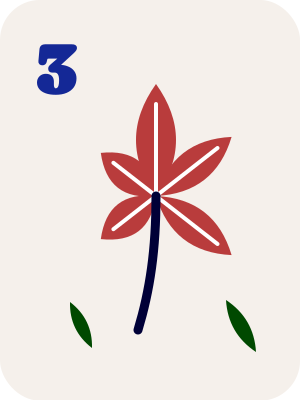
The flowers and seasons are numbered 1 to 4. Number 1 belongs to East, 2 to South, 3 to West and 4 to North. They are bonus tiles and never part of a set. Some home games leave them out and play with 136 tiles.
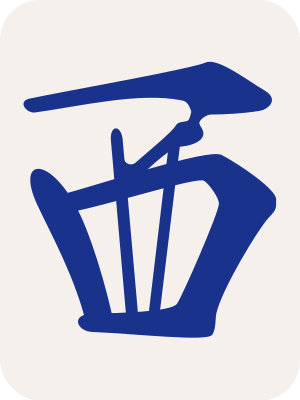
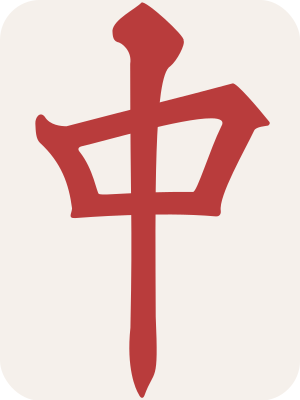
The Chinese names are often printed on tiles or used at the table: the Red Dragon is Zhong, the Green Dragon is Fa and the White Dragon is Bai. The winds are Dong (East), Nan (South), Xi (West) and Bei (North).
Setup and the deal
Take seats and choose the dealer
Each seat has a wind. The DealerThe player who starts the hand with 14 tiles and discards first. The dealer always sits in the East seat.See the full glossary is East, with South to the right, West opposite and North to the left. Roll the dice to choose the first East. Each player's wind for the hand is their Seat windThe wind of your seat for the current hand: East for the dealer, then South, West and North going round the table to the right.See the full glossary.
Build walls of 18 stacks
Shuffle the tiles face down. Each player builds a wall 18 stacks long and two tiles high, and the four walls are pushed together into a square.
Break the wall and deal
East rolls the dice to choose where to Break the wallChoosing where in the wall to start dealing, usually by rolling dice. The tiles are dealt from that gap.See the full glossary. Starting with East and going to the right, each player takes four tiles at a time until everyone has 12. Then East takes two more and everyone else takes one, so East has 14 and the others 13.
Replace flowers
Starting with East, anyone holding flowers or seasons puts them face up beside their hand and draws the same number of replacement tiles from the far end of the wall. Do the same any time you draw one during play.
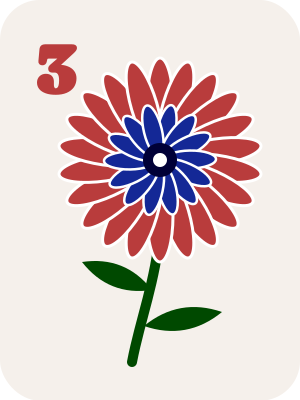

Bonus tiles go face up beside your hand, and you draw a replacement for each.
Playing a turn
East begins by discarding one tile. Then play goes to the right, and each turn is the same: draw the next tile from the wall, then DiscardThe tile you give up at the end of your turn, placed face up in the middle of the table and named out loud.See the full glossary one tile face up in the middle, saying its name. You always end your turn with 13 tiles, counting any sets you've laid down but not the extra tile of a kong.
Chow, pung and kong
You can CallTaking a tile another player has just discarded, to complete a set or to win. You say the name of the set, such as "pung", and lay the set face up.See the full glossary another player's discard to complete a set. Lay the finished set face up in front of you, then discard. Play continues from you, to your right.
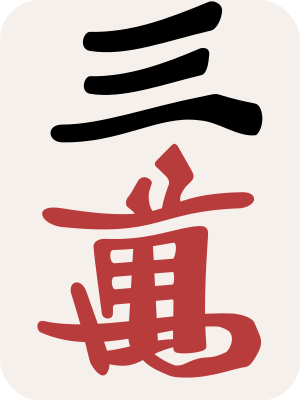
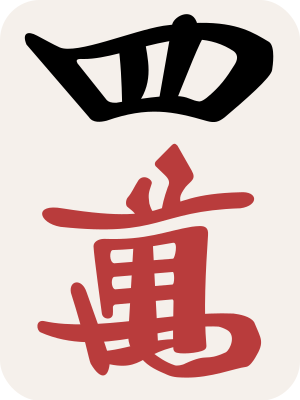
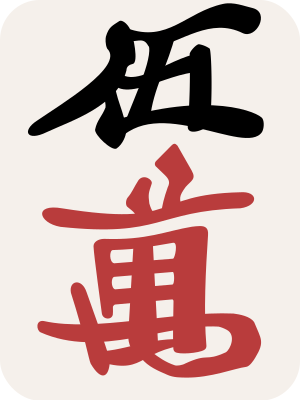
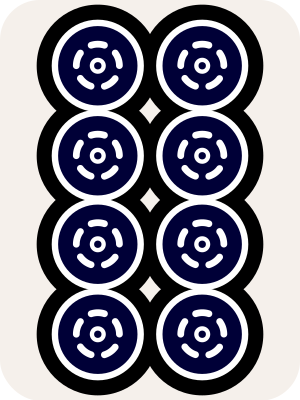
- ChowThree tiles in a row in the same suit, such as 4-5-6 of dots. Used in Chinese and Japanese mahjong, not in American mahjong. You can call a chow only from the player on your left.See the full glossary: three in a row in one suit. You can call a chow only from the player on your left, the one who plays just before you.
- PungThree identical tiles, such as three 7 Bams or three Red Dragons. You can call a pung from any player's discard.See the full glossary: three identical tiles. You can call it from any player.
- KongFour identical tiles. In Chinese and Japanese mahjong, a kong counts as one set and you draw a replacement tile after making it.See the full glossary: four identical tiles, which count as one set. You can call it from any player, make it from four tiles you've drawn yourself (a concealed kong, shown with the end tiles face down), or add a drawn tile to a pung you've already exposed. After any kong, draw a replacement tile from the far end of the wall.
Priority. A call to win beats a pung or kong, and a pung or kong beats a chow. A chow can never take a tile away from a player who wants it to win or for a pung.
Robbing the kong. If a player adds a tile to an exposed pung to make a kong, and that tile is the one you need to win, you can take it and win.
Winning hands
A winning hand has 14 tiles: four sets and a pair. A kong counts as one set, so a hand with a kong has an extra tile.
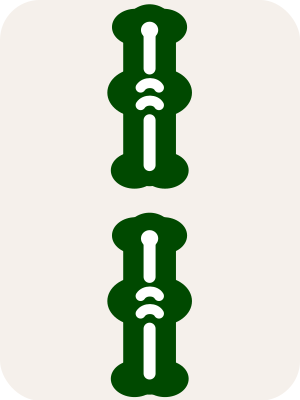
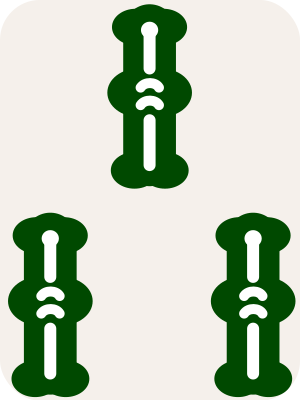
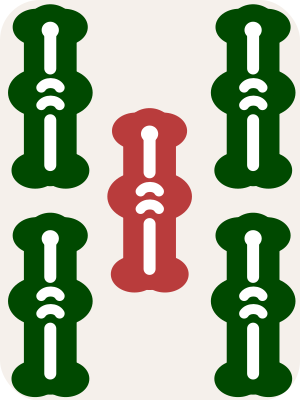
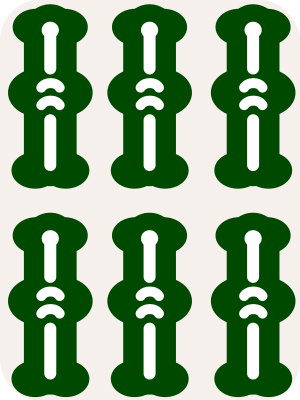
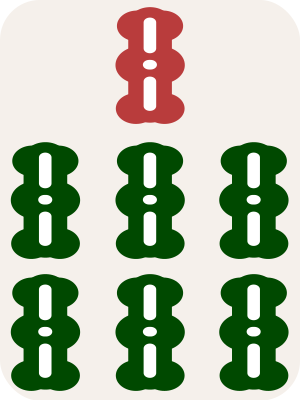
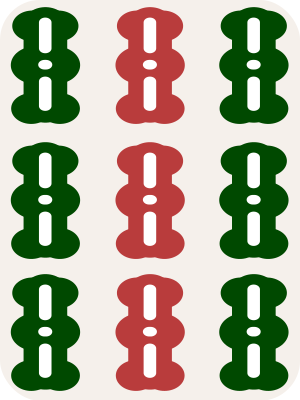
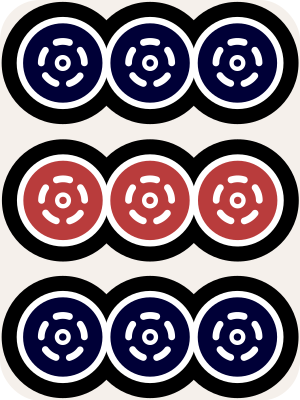
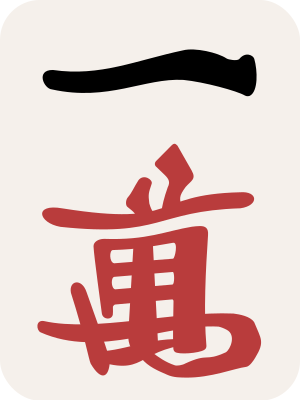
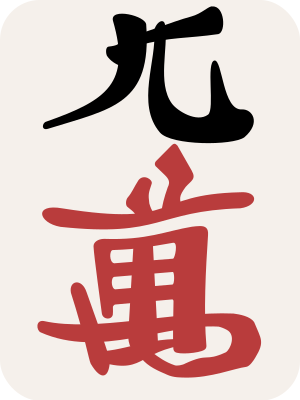
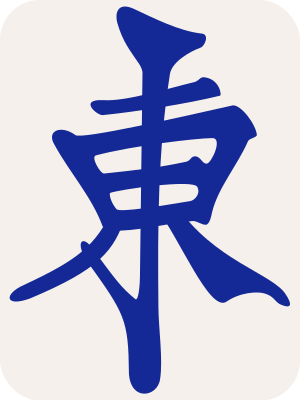
There are also a few special hands that don't follow the four-sets rule. The best known is Thirteen Orphans: one each of the 1 and 9 of every suit, every wind and every dragon, plus one extra copy of any of them. It is one of the rare top-scoring hands.


Simple scoring in faan
When you win, you add up your hand's FaanThe scoring unit in Hong Kong mahjong. Each feature of a winning hand is worth a number of faan, and the total sets how much the hand is paid.See the full glossary. Each feature is worth a set number, and many groups need a minimum, most often 3 faan, before a hand can win. Here are the common ones in Hong Kong rules:
| Feature | Faan |
|---|---|
| Self-drawn: you drew the winning tile from the wall | 1 |
| Concealed hand: no exposed sets (counts on a self-drawn win too) | 1 |
| No flowers or seasons | 1 |
| Each of your own flower and your own season | 1 each |
| Each pung or kong of dragons | 1 |
| Pung or kong of your seat wind | 1 |
| Pung or kong of the prevailing wind | 1 |
| All chows (no pungs), sometimes called a common hand | 1 |
| All pungs | 3 |
| Half flush: one suit plus honors | 3 |
| Full flush: one suit only | 7 |
| Thirteen Orphans | limit (top score) |
Example. You win with the half flush shown above, with the Green Dragon pung called earlier and laid face up, on a tile you drew yourself, and you hold no flowers. That's 3 for the half flush, 1 for the Green Dragon pung, 1 for self-drawn and 1 for no flowers: 6 faan.
The faan total is turned into money or points with a table that roughly doubles with each faan, up to a limit. Who pays also varies. In some groups the player who discarded the winning tile pays the whole amount; in others everyone pays, with the discarder paying more. Agree on your table and payment rule before you start.
Rounds, dealers and winds
A game is played in four rounds, named East, South, West and North. The name of the round is the Prevailing windThe wind of the current round. The game starts in the East round; a pung of the prevailing wind scores extra in Chinese and Japanese mahjong.See the full glossary, and a pung of it scores for everyone, on top of the bonus for your own seat wind.
Each round lasts until every player has been the dealer at least once. When the dealer wins, or the wall runs out with no winner, the dealer usually deals again (some groups pass the deal after a wall game). When someone else wins, the deal passes to the right, and everyone's seat wind moves along with it: the old South becomes East, and so on. After the fourth player has dealt, the next round begins with a new prevailing wind.
A full four-round game takes a few hours, so many families agree on a shorter game, such as one or two rounds, or play to a set time.
Hong Kong vs. Chinese Official rules
| Hong Kong (home play) | Chinese Official (MCR) | |
|---|---|---|
| Where you'll see it | Families, clubs, much of the Chinese diaspora | International tournaments |
| Scoring | Faan, usually 3 needed to win | 81 patterns in points, 8 needed to win |
| Flowers | Score faan if they match your seat | 1 point each, not counted toward the minimum |
| Seven pairs | Optional house rule | Standard hand |
| Learning curve | Quick: a handful of patterns | Slow: many patterns to learn |
If you're new, Hong Kong scoring is the place to start. Most of what you learn carries straight over to the competition rules.
Tips for your first games
- Aim for one or two scoring features early. With a 3-faan minimum, a fast hand with nothing special can't win. A dragon pung or a flush gives you something to build on.
- Keep the chow rule in mind. You only get one player's discards for chows, so pungs come along more often than you'd expect.
- Watch the discards. If two of a tile are already on the table, waiting for the third is a long shot.
- Agree on the house rules out loud. The minimum faan, the payment table, seven pairs and who pays on a discard all vary between groups.
Common beginner mistakes
- Chowing from the wrong player. Only the player on your left can give you a chow. If anyone else discards the tile, you need it for a pung or to win.
- Forgetting the replacement tile. After every kong and every flower, draw from the far end of the wall before you discard.
- Winning below the minimum. If your group plays with a 3-faan minimum, check your hand before calling mahjong. A hand that doesn't reach it can't win.
- Ignoring your seat wind. A pung of your own wind, or of the round's wind, is an easy faan. Hold on to a pair of it longer than a pair of the other winds.
- Exposing every set. Each call shows the table what you're building, and a hand with no exposures can earn a bonus.
FAQ
How many tiles are in a Chinese mahjong set?
144: 108 suit tiles, 16 winds, 12 dragons, and 8 flowers and seasons. Some groups play without the flowers and seasons, using 136 tiles.
Can you chow from any player?
No. You can call a chow only from the player on your left. Pungs, kongs and winning tiles can be called from anyone.
How many faan do you need to win?
Many Hong Kong groups need 3 faan, but plenty of home games use 1 or none. Agree before you start.
What happens when you draw a flower?
Put it face up beside your hand and draw a replacement from the far end of the wall. Your own flower or season (the one numbered for your seat) scores a faan if you win.
What is a chicken hand?
A winning hand that scores no faan at all. Groups with a minimum of 3 faan don't allow it; groups that play with no minimum do, usually for a small payment. Ask before you start.
Is Chinese mahjong the same as American mahjong?
No. American mahjong adds jokers, has a tile swap called the Charleston, and every winning hand must match that year's card. See how to play American mahjong.
See every tile in the mahjong tiles guide, print the mahjong cheat sheet, or go back to the beginner's hub.